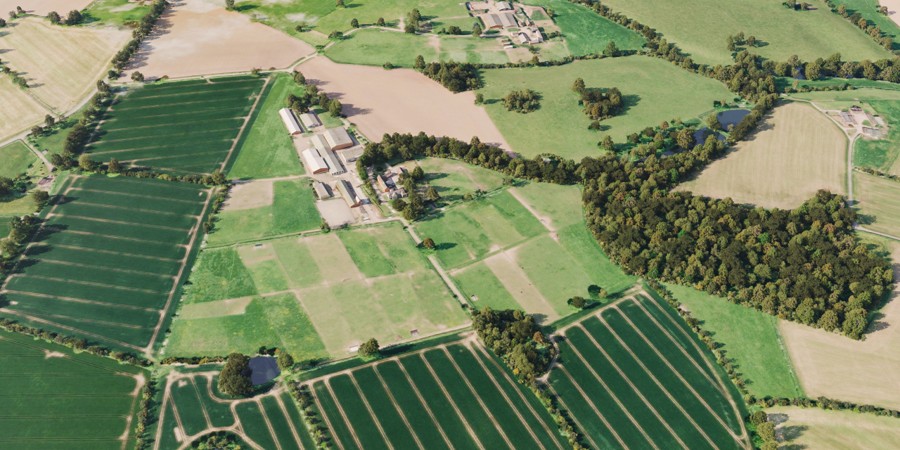
Eccleshall Habitat Bank is just a few miles away from Stafford
Environment Bank has announced the launch of its new Eccleshall Habitat Bank, a 50-acre nature recovery site located just a few miles from Stafford.
The site becomes the company’s sixth Habitat Bank in the West Midlands and forms part of its expanding national network of dedicated off-site Biodiversity Net Gain (BNG) projects.
Enhances existing habitats
Comprising four large pasture fields and an arable field, bordered by native hedgerow and woodland, the Eccleshall Habitat Bank has been designed to enhance existing habitats while strengthening ecological connectivity across Staffordshire.
The site will play a role in supporting developers to meet their biodiversity obligations, while also contributing to wider regional nature recovery.
BNG rules, which came into legislation in 2024, require all developers in England to leave nature in a measurably better state, delivering a minimum 10% improvement in biodiversity value through habitat creation.
The policy was introduced to address the UK’s accelerating biodiversity loss by embedding nature recovery directly into the planning system.
Aim to improve nesting opportunities
By enhancing existing hedgerows and grasslands, Environment Bank’s ecologists aim to improve foraging and nesting opportunities for a range of priority woodland and grassland species.
These include skylark, meadow pipit, reed warbler, sparrowhawk, lapwing, reed bunting and sedge warbler.
Expanded shrubland and woodland edge habitats will also provide suitable conditions for species such as the hedgehog and brown hare.
Marc Anderson, Lead Ecologist for Eccleshall Habitat Bank, said: “As the project ecologist, I am especially excited by the site’s unique location and the opportunities this Habitat Bank presents for local nature recovery.
“Our approach focuses on creating a diverse mosaic of habitats, from species-rich grasslands to strengthened woodland networks, as well as the creation of wetland habitats. Together, these habitats will form a vital connected network for wildlife, while also offering a powerful opportunity to inspire and engage the public in the importance of nature restoration.”
Positioned in a unique area
The site has been specially positioned to connect several locally significant nature areas, including Loyton Moss, Cop Mere and Doley Common Sites of Special Scientific Interest. Its design aims to strengthen ecological connectivity across the landscape and support broader nature recovery objectives within the county.
Required a detailed assessment
Following a detailed ecological assessment, Environment Bank is generating a range of high-integrity Biodiversity Units from the Eccleshall Habitat Bank, providing an off-site BNG solution for developers operating in the region. These Biodiversity Units are available to purchase now, subject to availability.
Eccleshall Habitat Bank is one of more than 45 sites within Environment Bank’s national network, created and managed by its team of ecologists in partnership with rural landowners.
Together, these sites cover more than 3,500 acres and will transform low-yielding farmland into nature recovery areas, unlocking over 8,500 off-site Biodiversity Units. The Eccleshall site is due to be added to the national biodiversity gain sites register in September 2026.
Helps to support national biodiversity targets
In addition to supporting national biodiversity targets, BNG schemes offer farmers and rural landowners opportunities to diversify income, enhance their landscapes and build long-term business resilience.
A public footpath running through the Eccleshall Habitat Bank will also allow local communities to experience the restoration of the landscape first-hand.