After 16 years, Orbán’s defeat sends shockwaves from Brussels to Moscow
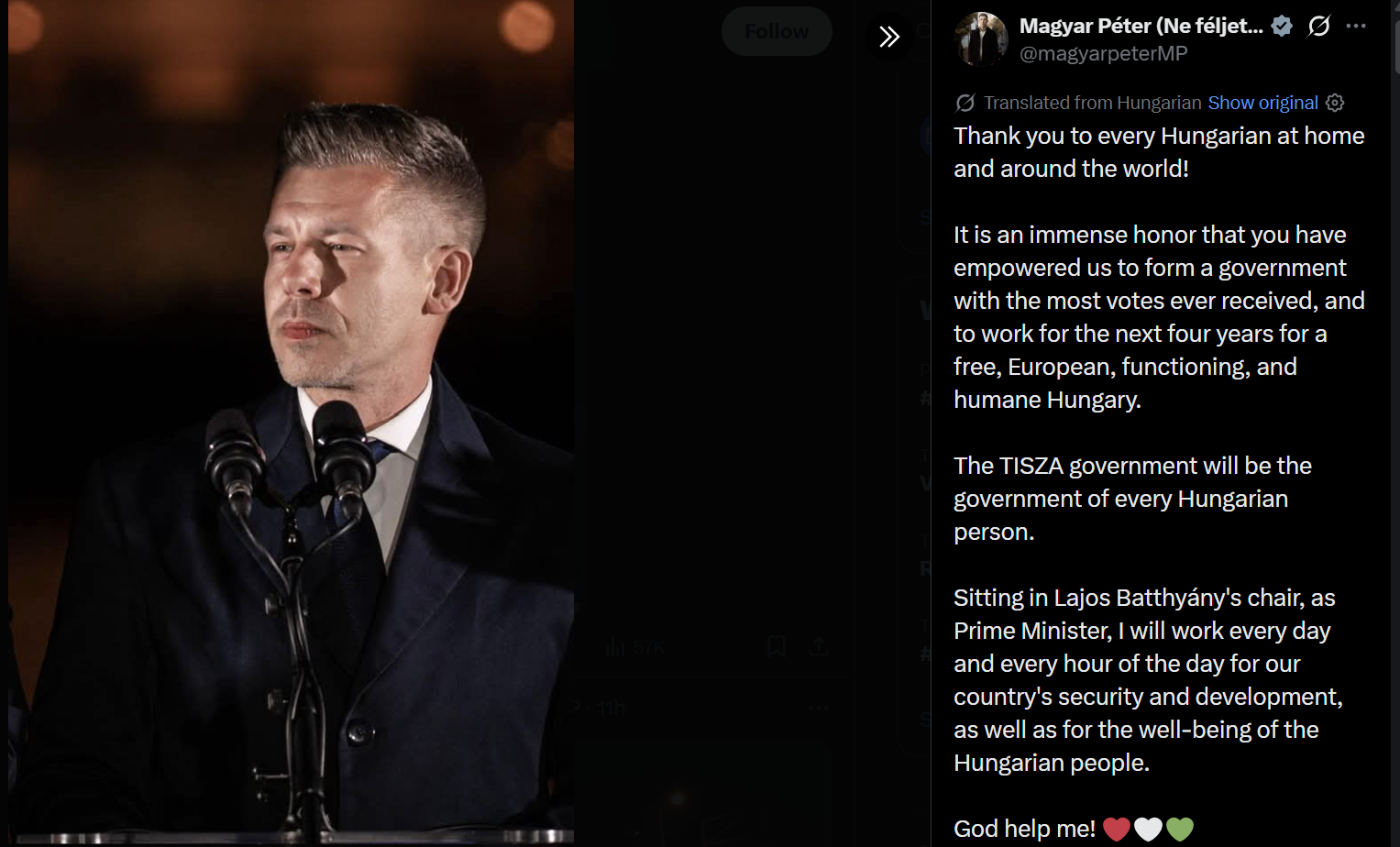
On Sunday Hungarian voters got rid of long-serving Prime Minister Viktor Orbán after 16 years in power. They rejected the authoritarian policies and global far-right movement he embodied in favour of a pro-European challenger.
With 99% of votes counted, Péter Magyar’s Tisza party won 138 of 199 parliamentary seats, a two-thirds supermajority, to Fidesz’s 55. Hungarian voters turned out in the greatest numbers since the fall of communism to oust Orbán’s Fidesz party.
The scale of the defeat was crushing. Orbán, the EU’s longest-serving leader and one of its biggest antagonists, had travelled a long road from his early days as a liberal, anti-Soviet firebrand to the Russia-friendly nationalist admired by the global far-right.
Last night, that road came to an abrupt end.
What Magyar inherits
Magyar’s supermajority gives his government the power to amend the constitution that Orbán rewrote to consolidate power. This was a tool Orbán himself used to reshape the judiciary, state media and the electoral system after winning his own supermajority in 2010.
Many Hungarians had grown increasingly weary of Orbán after three years of economic stagnation, soaring living costs, and reports of government-connected oligarchs amassing wealth. Magyar channelled that frustration into a cross-ideological coalition that proved irresistible.
Undoing Orbán’s changes will be central to unlocking roughly €17bn in frozen EU recovery funds, which Brussels withheld over rule-of-law concerns.
Addressing supporters along the Danube, Magyar said: “Tonight, truth prevailed over lies. Today, we won because Hungarians didn’t ask what their homeland could do for them. They asked what they could do for their homeland.”
Europe’s relief and Ukraine’s hope
The reaction from European capitals was effusive. European Commission President Ursula von der Leyen said “Europe’s heart is beating stronger in Hungary tonight,” adding: “Hungary has chosen Europe. Europe has always chosen Hungary. Together, we are stronger.”
British Prime Minister Sir Keir Starmer called it “a historic moment, not only for Hungary, but for European democracy.” German Chancellor Friedrich Merz urged Magyar to “join forces for a strong, secure and, above all, united Europe.”
For Ukraine, the implications are potentially transformative. As Orbán leaves office, Ukraine can hope to see Hungary’s new leader withdraw Budapest’s current veto of €90 billion worth of EU financial aid for Kyiv.
Orbán had repeatedly frustrated EU efforts to support Ukraine in its war against Russia’s full-scale invasion, while cultivating close ties with President Vladimir Putin and refusing to end Hungary’s dependence on Russian fossil fuels. Recent revelations showed a top government member had frequently shared the contents of EU discussions with Moscow.
Poland’s Prime Minister, Donald Tusk, offered congratulations in a social media post, adding in Hungarian: “Russians, go home!”
A bow to Trump and the global right
The stakes of Sunday’s election extended far beyond a Central European country of under 10 million people. Trump personally intervened in the final days of the campaign, sending Vice President JD Vance to Budapest. The White House had not responded to the election results by the time of writing. A telling silence.
Orbán had carved out a model of “illiberal democracy” seen as a blueprint by Trump’s MAGA movement and its European admirers. That model now faces its most serious test. Whether Magyar’s victory represents a broader turning of the tide against right-wing populism in Europe, or a specifically Hungarian reckoning with Orbán’s excesses, remains to be seen.
The future?
Magyar’s task is formidable. Many in Hungary and Europe hope the new government will reverse constitutional changes that weakened the independence of the courts, altered the election system, and restricted the rights of some minorities.
A defiant Orbán, for his part, gave no indication of abandoning politics.
“We are going to serve the Hungarian nation and our homeland from opposition,” he told followers.
For now, however, it is Magyar’s moment. And Europe’s. As one observer noted in Brussels, Orbán’s defeat was met with “a huge sigh of relief.”
After 16 years, Hungary has chosen a different path.