
Hoxton Mix’s analysis of Companies House data found that 47.2% of company directors’ details examined use an address that appears residential on the public register.
- The Directors Privacy Report 2026 encapsulates analysis of 5,000 active companies on Companies House with 7,736 directors.
- Nearly half (47.2%) of the 7,736 directors analysed had an address that appeared residential, based on indicators such as “Flat”, “Apartment” and “Cottage” in their publicly listed Companies House records.
- Among the 6,294 addresses that could be confidently classified, this rises to nearly 6 in 10 (58%).
- Solo entrepreneurs are more than three times as likely to use an apparent residential address as directors at businesses with three or more directors (61.5% vs 18.6%).
- Newer businesses are more likely to have directors using residential addresses, with more than half (53.5%) of companies aged 0-2 years falling into this category, compared with two-fifths (41.1%) of companies aged 11+ years.
An estimated three million UK company directors could be using an address that appears residential on the public Companies House register, according to new research by Hoxton Mix. The findings come as artificial intelligence makes it increasingly easy to use publicly available personal information to create sophisticated impersonation and fraud attempts.
The Directors Privacy Report 2026, from virtual office provider Hoxton Mix, analysed a random sample of 5,000 active UK companies and 7,736 unique directors on Companies House to examine how frequently publicly listed service addresses appear to be residential.
Residential or likely residential addresses were identified using indicators such as “Flat”, “Apartment” and “Cottage”. Commercial addresses were identified using indicators such as “Office”, “Business Centre”, “Unit”, “Business Park” and “Industrial Estate”, alongside known virtual-office and professional service addresses.
Across the entire sample of 7,736, nearly half (47.2%) of directors had an address classified as residential or likely residential. If the same proportion were reflected across the estimated 6 to 7 million [1] company directors and people with significant control expected to require Companies House identity verification, it would equate to around three million people potentially exposing their home address.*
Solo entrepreneurs are three times more likely to expose their home address than directors of larger businesses, with over three fifths (61.5%) classified as either residential or likely residential. This significantly contrasts companies that have three or more directors where the figure falls to just under two fifths (18.6%). More than half (53.5%) of directors at businesses aged 0–2 years appeared to use a residential address, compared with 41.1% of directors at businesses operating for 11+ years or more. This tells us that privacy could be particularly easy to overlook during the early stages of starting a company when directors are making multiple decisions at once.
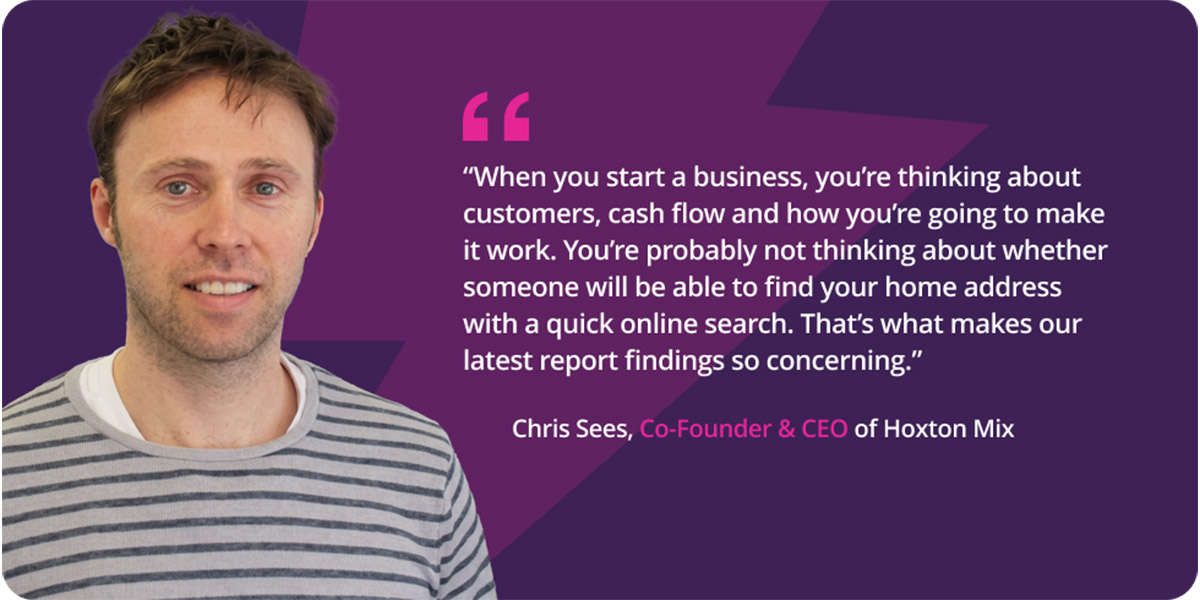
Chris Sees, Hoxton Mix’ CEO comments: “When starting a business, directors are thinking about customers, cash flow and how you’re going to make it work. They’re not thinking about whether someone will be able to find their home address with a quick online search and what that individual might be able to do with it. That’s what makes these findings so concerning.”
“In an age of AI-powered impersonation and increasingly sophisticated fraud, your name, business and home address can become valuable pieces of a puzzle for scammers. The more personal information available publicly, the easier it can become to build convincing, highly targeted attacks or attempts to steal someone’s identity. Privacy needs to become part of the business set-up conversation from day one”.
Starting a business inevitably means putting some information into the public domain, but our research suggests many directors could be sharing more than they realise. The takeaway is simple; your business can be public without your home having to be.
To find out more about protecting privacy when running a business, including how a virtual office address can help keep your residential address separate from your company, visit Hoxton Mix.