
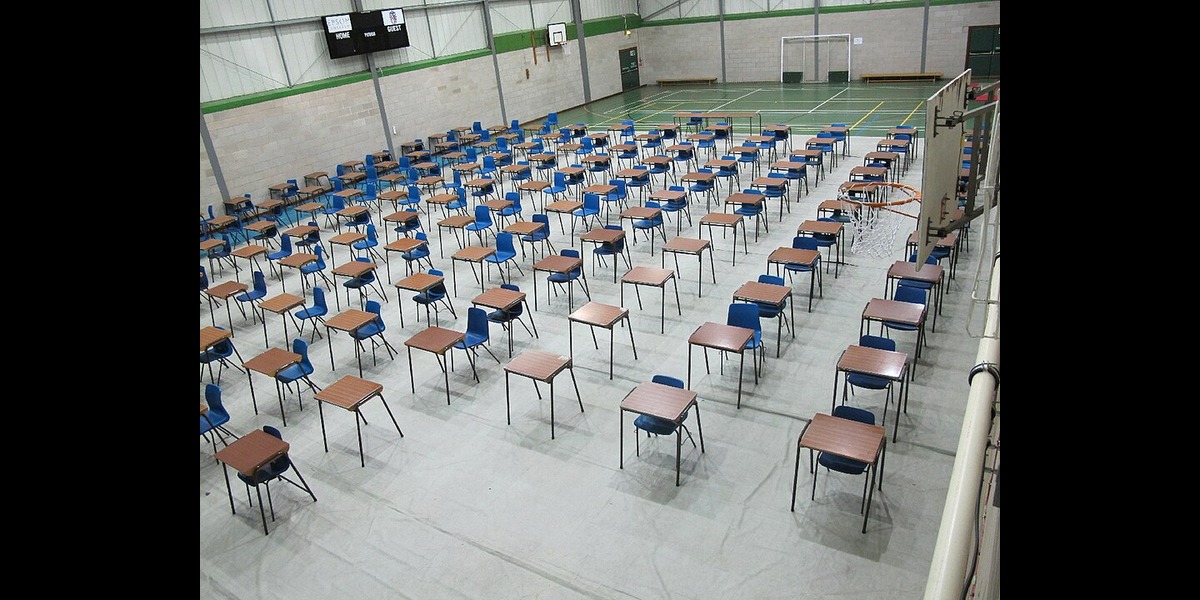
One exam. A few hours. A grade that can seem to define your entire future. But does a person’s performance in an examination truly reflect how intelligent they are?
Imagine spending months revising, sacrificing your free time, missing out on social occasions and repeatedly testing your knowledge, only to sit in an examination hall for a few hours and have your abilities judged by a single result. For generations, examinations have been regarded as one of the most reliable ways of measuring academic achievement. Yet, in a society that increasingly celebrates individuality, creativity and innovation, perhaps it is time to question whether our education system has become too dependent on examination results. After all, can intelligence really be reduced to a number on a piece of paper?
There is no denying that examinations serve an important purpose. They provide students with an opportunity to demonstrate their knowledge, encourage independent learning and allow schools to assess academic progress. Without some form of assessment, how would teachers determine whether students have understood what they have been taught? Furthermore, examinations establish a relatively standardised system, allowing students to be assessed against the same criteria. In this sense, exams can be useful. However, the real question is whether they measure intelligence itself, or simply how well someone performs under specific conditions.
Intelligence is not one-dimensional.
Human intelligence is remarkably complex. It encompasses far more than the ability to memorise information, recall facts or construct a well-written essay under time pressure. Creativity, emotional intelligence, practical problem-solving, communication and critical thinking are equally valuable abilities, yet many of these qualities remain largely unrecognised within traditional examination systems.
Consider an exceptionally talented musician who can compose extraordinary pieces of music, or an entrepreneur who possesses the imagination and determination to transform an idea into a successful business. Would their intelligence suddenly become less significant if they struggled to achieve the highest grades in mathematics or science? Of course not. Their abilities simply exist beyond the boundaries of what examinations are designed to assess.
Perhaps the greatest flaw in our education system is not that examinations are entirely ineffective, but that we have allowed them to become such a dominant measure of success. We risk overlooking extraordinary potential simply because it does not fit neatly into an examination paper.
The psychological pressure of examinations.
Beyond the question of intelligence lies another equally important issue: the enormous pressure placed upon students to succeed.
For many young people, examinations are not simply academic assessments; they become defining moments that appear to determine their futures. The constant reminders to revise, achieve high grades and meet expectations can create an overwhelming sense of responsibility. Students are frequently told that their examination results will influence their university opportunities, career prospects and future success. Consequently, it is hardly surprising that many begin to associate their self-worth with their academic performance.
The pressure does not always come from schools. Expectations from parents, comparisons with friends and the increasingly competitive nature of education can all contribute to the burden students experience. Social conversations that revolve around predicted grades, revision schedules and academic achievements can make it difficult for individuals to feel satisfied with their own progress. Even students who perform exceptionally well may experience anxiety about maintaining their results.
Of course, a certain amount of pressure can be beneficial. Deadlines can encourage discipline, examinations can motivate students to work towards their goals, and overcoming challenging situations can develop resilience. However, there is a significant difference between healthy motivation and overwhelming stress. When the fear of failure becomes greater than the desire to learn, has education lost sight of its original purpose?
Stress can also affect the very abilities examinations are supposed to measure. A student might spend weeks understanding a particular subject, only to struggle to recall information when faced with the pressure of an examination hall. Nervousness, lack of sleep and fear of disappointing others can all interfere with concentration and performance. Does this necessarily mean that the student lacks knowledge or intelligence? Certainly not. It may simply mean that the conditions in which they are being assessed do not allow them to demonstrate their full potential.
But is there another side to the argument?
It would be unfair to suggest that examinations should simply be abandoned. Academic assessments have an important role in preparing students for future challenges. Learning to manage deadlines, organise information and work independently are valuable skills that extend far beyond the classroom. Furthermore, examinations can provide students with a sense of achievement, allowing them to recognise the progress they have made through dedication and perseverance.
However, perhaps the solution is not to remove examinations entirely, but to reconsider how heavily we rely upon them. Coursework, presentations, practical assessments, collaborative projects and creative assignments could all provide additional opportunities for students to demonstrate their abilities. A broader approach to assessment would recognise that individuals learn differently and possess different strengths.
Education should not be a competition in which the only definition of success is achieving the highest possible grade. Instead, it should be an opportunity to discover interests, develop skills and cultivate a genuine understanding of the world. Surely the purpose of education is to prepare young people for life, not simply to prepare them for their next examination?
A grade does not define a person.
Ultimately, examinations can tell us a great deal about someone’s academic performance, but they cannot tell us everything about their intelligence, character or potential. They cannot measure someone’s kindness, imagination, determination or ability to overcome adversity. Nor can they predict every achievement that an individual might accomplish throughout their lifetime.
We must be careful not to confuse academic success with personal worth. A disappointing examination result should never be interpreted as evidence that someone is incapable, unintelligent or destined to fail. Equally, achieving outstanding grades should not become the sole expectation placed upon those who perform well.
Perhaps it is time to change the way we think about intelligence. Rather than asking how well someone performs in an examination, we should ask what they are capable of achieving when given the opportunity to explore their abilities.
After all, an examination can measure what someone knows in a few hours, but it cannot measure everything they have the potential to become. A grade may reflect someone’s performance, but it should never define their intelligence.