Brandauer: Birmingham’s hidden giant of innovation and enterprise
You’ve probably driven or walked past it countless times. On New John Street West, just round the corner from Summer Lane, it looks at first like one long red-brick hulk: arched gateways, tall sash windows, a proud chimney poking skywards.
But look closer and you see it isn’t one block at all. It’s a series of ranges stitched together across decades, a double-courtyard plan with a power house and its own stack. In many ways the building itself sets the scene, not quite what it first appears, but something far more complex and, indeed, better.

This is the former Brandauer Works, a Grade II-listed Victorian masterpiece. Once alive with the clatter of presses, now it sits silent, a reminder of Birmingham’s industrial backbone. Thousands pass it daily in the ring-road traffic, yet few know its story.
Birmingham: a potent mix of cultures, skills and talents
To place it more firmly: the old works sit at the junction of New John Street West and Summer Lane, within sight of the police base where patrol cars still cluster. A short walk takes you to the Crocodile Works on Alma Street, another slice of Birmingham’s industrial heritage. Ten minutes more and you’re in the heart of Aston University’s campus or the Jewellery Quarter. Even the weekly shop gives bearings: Tesco’s Aston Lane superstore has been serving locals since the mid-2000s, with ALDI up the road in Newtown.
Even the name catches the ear. Brandauer, not what you’d call a classic Brummie name. But then again, what is? This is the city of Iommi, of Karin and Brenda Hall, of Ranjit down the road. Names that carry their own music, their own weight. Birmingham has never been about “pure” anything. It’s always been a melting pot, a place where outside names and skills settled, and over time became as Brummie as the canals and the accent. Brandauer belongs here as much as any of them.
From pen nibs to precision pressings
That building is more than bricks. It’s a statement: Birmingham once made things, precise things, with a skill the world could not match. Brandauer’s nibs, yes, the humble pen nibs, were famous across the globe, flowing out of those courtyards into classrooms, offices and parliaments. The building may no longer thrum, but the company it housed is still very much alive, and still shaping the world.
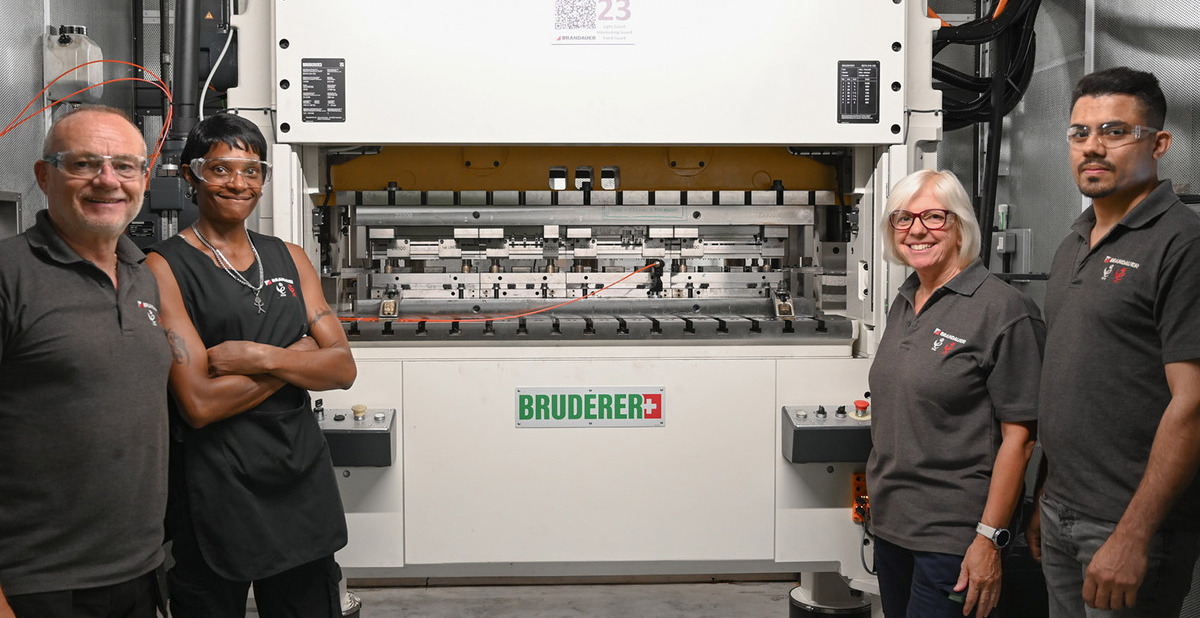
Today, Brandauer is tucked into more modern premises nearby. The nibs are long gone, but the ethos remains: precision engineering, crafted in Birmingham, shipped to the world. Instead of nibs, it’s connectors, frames, stamped laminations, components so small you’ll never see them, but without which cars don’t start, razors don’t shave, and electronics don’t switch on. Like the building, the company isn’t quite what it first appears: unassuming from the outside, but look closer and you find something far more intricate, vital, and impressive.

A global export powerhouse
Three-quarters of what Brandauer stamps leaves Britain’s shores. Twenty-seven countries at last count, from India to Egypt, from Europe to North America.
- A £4 million contract with LORD International in Egypt will see their Birmingham-made razor components in bathrooms across Africa and the Middle East.
- A £1.5 million order from India for automotive press-fit connectors means 30 million parts a year, Birmingham components at the heart of a global car supply chain.
This isn’t low-end outsourcing. It’s high-tolerance, ultra-precision work where there is no margin for error. A bad batch would halt a production line on another continent. That level of trust says it all: the world believes in Brandauer.
Skills, craft, continuity
The workforce is lean, about 60 strong, but highly skilled. Apprentices come through their Precision Toolmaking Academy, learning CAD, high-speed tooling, and wire EDM. The company has ploughed £3.25 million into new presses and technology, and it shows: their reputation grows even as Britain frets about “lost industry.”
Recognition has followed. The King’s Award for Enterprise is pinned proudly to their name. CEO Rowan Crozier holds an MBE for services to manufacturing and enterprise. These aren’t token gestures: they’re acknowledgements that this is a world-class operation.
Why this matters to Birmingham
The old works on New John Street West is a visual reminder, but the living company is the real story. It’s Birmingham’s quiet triumph: an exporter, a trainer of talent, a global player. We are rightly quick to cheer our football clubs, our music and our street food, but where is the civic pride in a firm like Brandauer?

‘Sinews of global commerce’
The truth is this: without companies like Brandauer, supply chains grind to a halt. They are the steel sinews of global commerce. And they’re ours. Not Berlin’s. Not Detroit’s. Birmingham’s.
So next time you drive past that silent old factory by Summer Lane, take a moment. At first it looks like one long block, but look closer and you see something more layered, more remarkable, just like the company it once housed. That shell once made Birmingham a global name. And behind the scenes, in cleaner workshops just down the road, its spirit still does. It is time, long past time, that we as a city, as a region, celebrate Brandauer with pride.