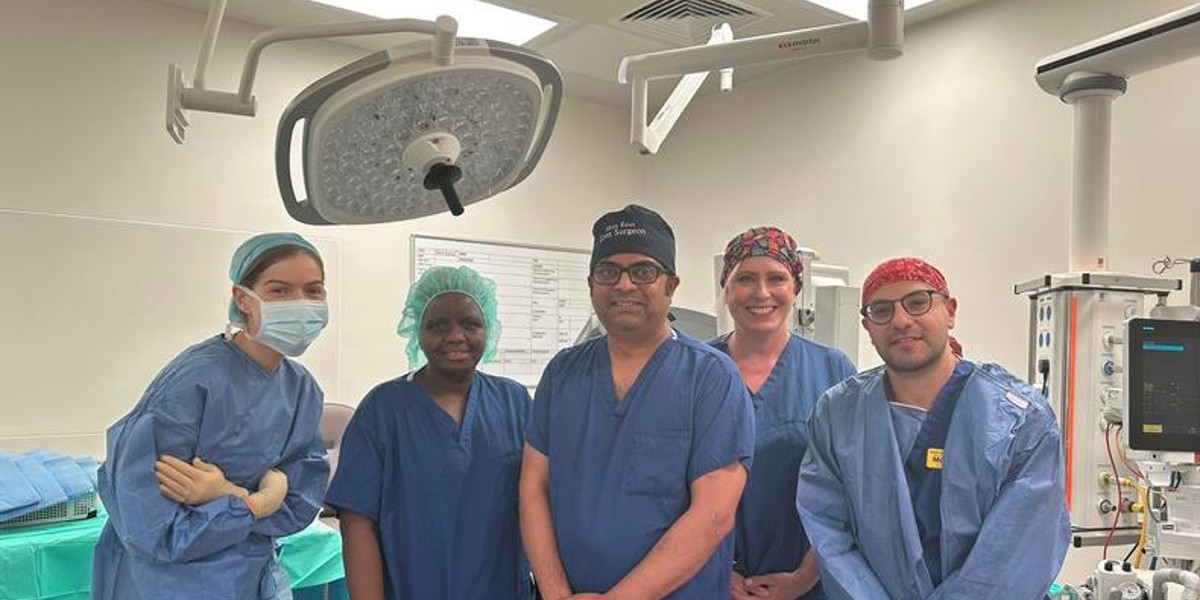
Surgeons at Midland Metropolitan University Hospital have performed the region’s first robotic transanal minimally invasive surgery (r-TAMIS).
This marks a major milestone in colorectal treatment for Birmingham and the Black Country.
Improved accuracy
Unlike conventional methods, the robotic technique enables the removal of polyps in one piece, allowing for clearer analysis and better detection of cancerous tissue.
The first patient to undergo the procedure was 54-year-old Steven Millward from Oldbury, who previously had emergency surgery for bowel cancer in 2020.
A follow-up check revealed a polyp showing early signs of malignant change, prompting doctors to opt for the new approach.
Colorectal surgery
Colorectal refers to surgeries on the rectum, anus or colon and polyps refer to benign tumours that have the potential to become cancerous.
The r-TAMIS procedure allows surgeons to remove rectal polyps and early-stage cancers using a robotic system. It offers greater precision and manoeuvrability.
It aims to reduce the need for major surgery or permanent stomas (a surgical opening in the abdomen), improving outcomes and recovery times for patients.
The da Vinci robot
The Sandwell and West Birmingham NHS Trust has used standard TAMIS since 2024, but this is the first time the advanced robotic version has been used.

Operated through a da Vinci surgical system, r-TAMIS allows one surgeon to control both the camera and surgical tools simultaneously via a console.
da Vinci robot
The da Vinci robot is a machine that can carry out surgeries previously limited to experienced, trained experts.
The da Vinci SP (single port) robot helps further minimise invasiveness, which is key when working with sensitive areas such as the anus, as only one incision is needed.
Looking to the future
Consultant Colorectal surgeon Mr Shantanu Rout, who led the operation, said: “NHS England has recently announced that they are anticipating a significant expansion of robotic surgery to speed up patient care and cut down waiting lists. By 2035, it’s estimated that 90 per cent of all keyhole surgery will be robotic.
“I’m delighted that we are able to provide this robotic approach for rectal lesions at the Midland Metropolitan University Hospital. It makes me proud to be able to provide state-of-the-art care for our patients.”
The newly built hospital in Smethwick, home to 11 surgical theatres and two maternity theatres, has been key to enabling robotic surgery with capacity for further expansion in the years ahead.