The Rocester manufacturer is investing £100m in its World HQ as its hydrogen-powered car sets a new record of 406.320mph.
JCB is accelerating investment in its future, fresh from setting a new world land speed record with its hydrogen-powered JCB Hydromax.
Last month, the Hydromax, driven by Wing Commander Andy Green OBE, reached 406.320mph (653.909km/h) at the Bonneville Salt Flats in Utah. That made it the fastest hydrogen-powered vehicle ever, more than doubling the previous hydrogen combustion record. It also beat the diesel record set by JCB’s own Dieselmax 20 years earlier.
The car was powered by two production-based hydrogen engines built at JCB’s factory in Foston, Derbyshire, and went from idea to world record in 18 months.
Hydrogen engines in production
The record follows JCB’s £100 million programme to develop hydrogen combustion technology. Hydrogen-powered machines are now in production, and JCB says it is the first construction equipment company in the world to bring a fully approved hydrogen-fuelled combustion engine to market.
George Bamford said: “From the day my grandfather founded JCB in 1945, innovation and investment in Great Britain has been at the heart of everything we do. JCB Hydromax showed the world what British engineering can achieve. That same spirit is in every machine we build. While JCB has expanded globally over the years, our home has always been here, and the record investment we are making in our facilities and in new products is good news for Britain and good news for JCB.”
£100 million for Rocester
JCB is investing £100 million in transforming its World HQ in Rocester, the company’s home since 1950. That was the year founder Joseph Cyril Bamford moved production into a former cheese factory in the village.
The work includes a £60 million fully automated powder paint plant and a comprehensively modernised shop floor. JCB says these will help secure the future of more than 8,000 UK jobs.
In the United States, JCB’s new $1 billion factory in San Antonio, Texas, opens next month. At one million square feet, it will be the company’s largest factory in the world. It will build Loadall telescopic handlers and access equipment for North America and create 1,500 jobs over the next five years.
New Joint Chairman
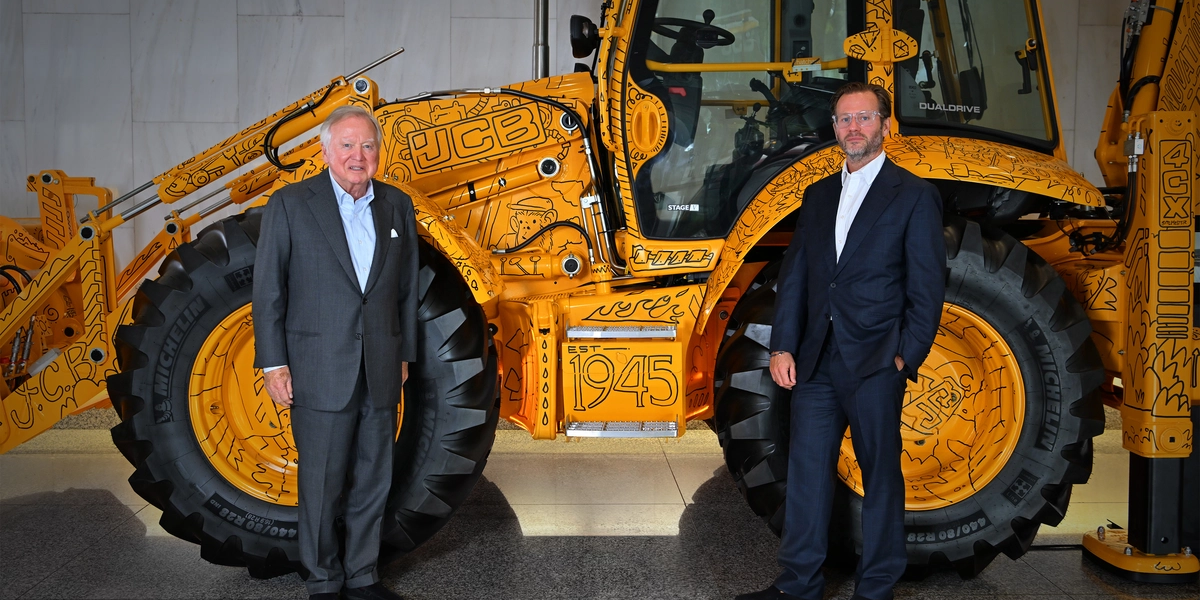
As part of its next chapter, George Bamford will become Joint Chairman alongside his father, Lord Bamford. It is the first change at the top of JCB in more than 50 years. Over that time the company has grown into one of Britain’s largest privately owned manufacturers, with 23 factories and more than 20,000 employees worldwide.
Lord Bamford said: “Last year JCB celebrated its 80th birthday and, as we look ahead, we are investing heavily in the future of the business, from the transformation of our Staffordshire headquarters and pioneering hydrogen technology, to our new factory in Texas. As part of that next chapter, I’m delighted that my son George will become Joint Chairman of JCB. We have never been a company that stands still, and these investments will ensure JCB is well placed to seize the opportunities ahead.”
2025 results
JCB reported sales turnover of £5.7 billion for 2025, compared with £5.8 billion in 2024. Profit before tax was £642 million, down from £687.3 million. Machine sales fell from 119,848 to 113,498 units, and the business remained debt-free with no net borrowings. It still increased its global market share, despite flat demand in North America and a 12% market contraction in India.
Chief Executive Graeme Macdonald said: “While 2025 was a more challenging year with mixed market conditions around the world, JCB delivered a robust performance overall. Machine sales were down by around 5%, but turnover remained broadly stable due to a more favourable market and product mix. Despite nil market growth in North America and a 12% market contraction in India, both important markets for JCB, we increased our global market share during 2025, which is an encouraging result. The overall outlook for 2026 is for moderate growth, despite ongoing geopolitical uncertainty, and with new capacity coming on stream in Texas and Staffordshire we are well placed to take advantage of it.”
Skills pipeline
The JCB Academy, championed by Lord Bamford to tackle the UK’s engineering skills shortage, received 708 applications for 314 places this September. Since opening in 2010, it has educated around 3,750 young people, and every leaver has gone on to employment or further education. This month JCB also took on 116 new apprentices, undergraduates and graduates, selected from more than 6,300 applicants.