
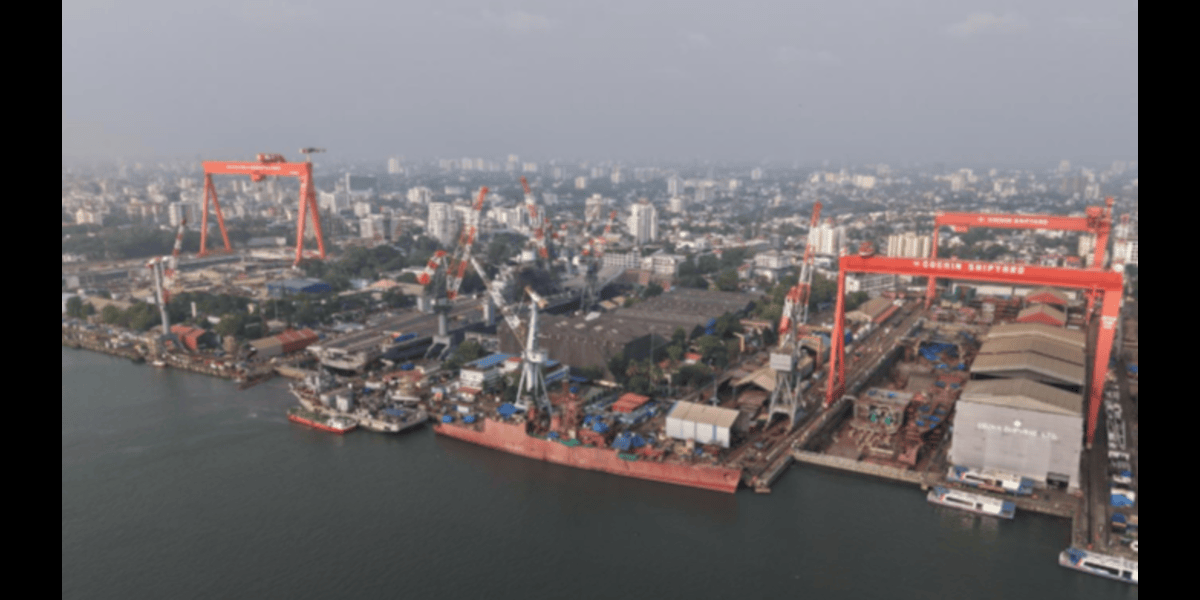
Cochin Shipyard will replace steam propulsion and modernise its weapons, while British firms and the Royal Navy look to a growing and strengthening Indian partnership
India’s Ministry of Defence has awarded a £40m contract to refit and re-power one of its older frigates. The agreement comes as the UK and India pushing to pursue greater cooperation among their defence industry, from joint naval exercises to shared industrial projects.
The contract with state-owned Cochin Shipyard Limited (CSL) covers the normal refit and re-powering of INS Betwa. It was signed in the presence of Defence Secretary Rajesh Kumar Singh in New Delhi on 11 November 2026.
Steam out, diesel in
INS Betwa, a Brahmaputra-class guided-missile frigate, is set to undergo a significant upgrade, its existing steam propulsion system will be replaced with diesel engines, alongside the installation of an upgraded weapons package designed to improve its operational capabilities. Steam propulsion is usually less economical and efficient to run and demanding to maintain than modern diesel systems. Converting a ship mid-career means reworking the machinery spaces at the heart of the vessel rather than simply swapping an engine.
According to the The Ministry of Defence, the project would support the Aatmanirbhar Bharat (self-reliant India) and make in India programmes and reinforce the country’s ability to carry out complex naval repair work at home. The announcements reviewed give no completion date and no details of the new engines or weapons.
Following the INS Beas template
The planned work on Betwa follows a similar programme already undertaken on its sister vessel, INS Beas. In October 2023, the ministry signed a £25m contract with CSL to re-power INS Beas, the first Brahmaputra-class frigate converted from steam to diesel, making it the first frigate in the Brahmaputra class to undergo this change. It said the project would involve more than 50 small and medium-sized enterprises and create jobs for more than 3,500 people. Work began in early April 2024.
The UK connection
Although the INS Betwa programme is being delivered entirely within India, it comes at a time when defence cooperation between New Delhi and London is expanding.
In early September, reports indicated that India and the UK were nearing agreements to covering two separate defence programmes. One cover integrated full electric propulsion for four Indian Navy landing platform docks, and the other covers Martlet lightweight multirole missiles for the Indian Army. Royal Navy’s experience with this propulsion technology, including on the Queen Elizabeth-class carriers, provides India with valuable support, while India develops their own capabilities.
The two governments are working on a 10-year Defence Industrial Roadmap under India-UK Vision 2035, and the UK has set up a dedicated Defence Partnership-India programme office. India has also invited British companies to explore opportunities in its defence corridors in Uttar Pradesh and Tamil Nadu.
What it means for the UK defence sector
India remains one of the world’s largest defence procurement markets and is seeking foreign firms to partner with its domestic industry. The Betwa contract demonstrates India favouring local yards, so British firms are more likely to win work as technology and component partners than as prime suppliers of finished ships. Potential agreements covering propulsion technology, missile production and naval electronics could provide additional work for British manufacturers and engineering businesses. This may help support specialist skills, manufacturing capacity and jobs as demand for defence equipment continues to grow across Europe and beyond. Also, the Royal Navy is also likely to benefit from the stronger industrial and naval relationships with India.
There are limits to this. India’s emphasis on self-reliance means it will keep pushing for local content and technology transfer, which can narrow the margins and the volume available to overseas suppliers.
What happens next?
With the contract signed, attention turns to the delivery programme. The key questions will be how quickly CSL can begin work on Betwa, how the yard balances this project against its other commitments, including the Vikramaditya refit and its shipbuilding orders, and whether the experience gained on Beas translates into a smoother schedule.
The progress of INS Beas will be particularly important. The vessel was expected to return to service in 2026, its eventual completion will make a useful indicator of how successfully the shipyard has managed the first steam-to-diesel conversion in the class.
UK interests will be following closely too. Under a 2022 logistics agreement, Royal Navy ships deployed in the Indian Ocean can obtain spares, supplies and essential repairs at Indian shipyards, so a more capable repair sector in India is of direct practical value to British naval operations in the region. India and the UK were also reported in September to be close to finalising agreements on electric propulsion for Indian Navy landing platform docks and on Martlet missile production, so further progress on those could shape how much of India’s future naval work involves British technology and suppliers. I could not confirm that either agreement has been signed.
For now, the contract marks another step in India’s push to build up its own naval maintenance base, and a further sign that refit and re-powering work on ageing warships is becoming a regular part of the Indian Navy’s planning. For the UK, it is part of a wider picture of a close and growing defence partner.