
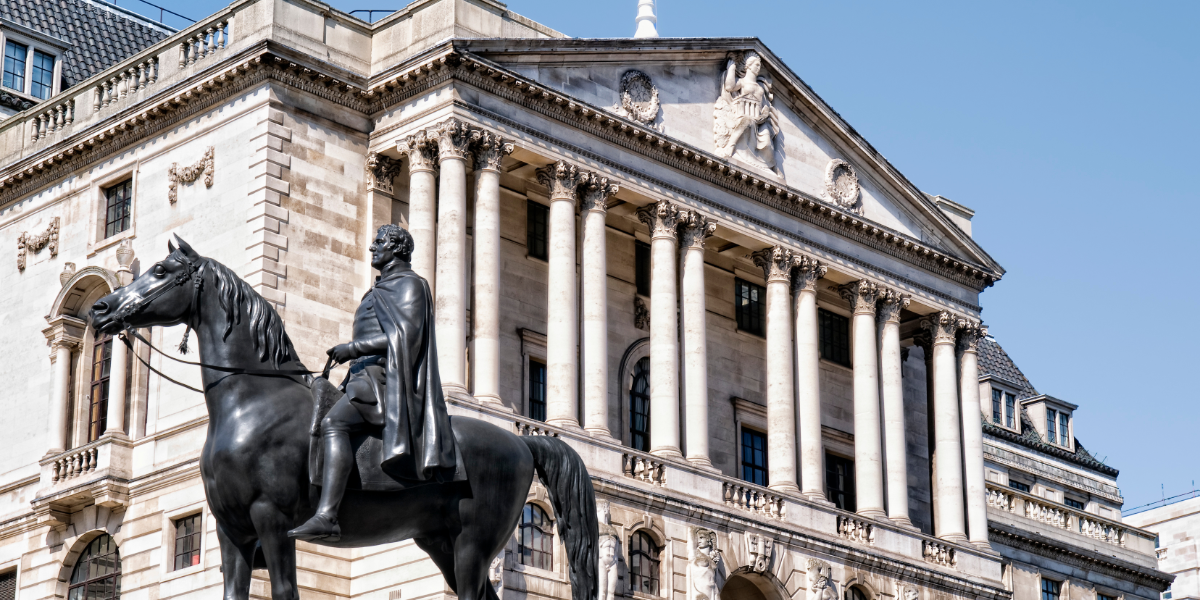
The Bank of England’s Monetary Policy Committee meets this month to vote on whether to raise or lower the base rate
With the Bank of England’s Monetary Policy Committee set to meet in February, when it will reevaluate the base rate, let’s take a look at the factors committee members will consider, what changes in interest rates mean for consumers, and why striking a perfect balance between interest rates and inflation is so important.
Who is the Monetary Policy Committee?
The Monetary Policy Committee (MPC) is made up of nine members, including the Governor, the three Deputy Governors for Monetary Policy, Financial Stability and Markets and Banking, the Bank of England’s Chief Economist and four external members appointed by the Chancellor.
External members are appointed to ensure that the decisions of the MPC are guided by expertise from outside of the Bank of England. Although a representative from the Treasury does sit with the Monetary Policy Committee, they do not vote. They are primarily there to ensure that the MPC is fully briefed on fiscal policy development.
Each of the nine members of the MPC will make their proposal on interest rates. Then each of the members will vote on the proposals. The vote is not a simple yes or no, but rather a vote on different proposals until one achieves a simple majority, which will determine whether the interest rate will change or not.
Considerations of the MPC
Although there is a range of considerations for the MPC to consider, inflation is by far the most important one of these considerations. Inflation is one of the core responsibilities of any central bank, such as the Bank of England.
The committee will look closely at the CPI (Consumer Price Index). However, it will also look at ‘core’ inflation, which doesn’t consider volatile items of the CPI basket such as energy. The MPC will look at the driving pressures of inflation and not just the headline figure. It will consider whether inflation is driven broadly, or just by particular parts of the economy.
Wage growth and the labour market are also important considerations for the bank. If wages are rising quickly and unemployment is low, though these may seem positive on the surface and to consumers, for the MPC, this could be a cause for concern, as they may worry that inflationary pressures are building domestically.
Economic growth will also serve as food for thought. Though economic growth is often most widely seen as a responsibility of the treasury, the Bank of England does have some responsibility for it. GDP figures and business investment are important factors.

What do interest rates really mean?
Well, the interest rate has different implications depending on your spending habits as a consumer or business. For example, whilst net borrowers it acts as the cost of borrowing, for net savers, it serves essentially as a reward for saving. From the Bank of England’s perspective it is mainly a tool for controlling inflation however.
For consumers, high interest rates can be detrimental. Households with mortgages, car loans and other long-term financial borrowing initiatives, can be negatively affected by an increased cost of borrowing. But other households, such as those who’ve paid off their mortgages and have savings can benefit from increased interest accumulating on their savings.
Meanwhile, the opposite is the case when we see lower interest rates. Households with mortgages don’t have to pay as much back in their mortgage payments in the forms of interest whilst those with large amounts of savings suffer as they get less back from their savings.
For businesses, similar factors are at play. Firms may be more incentivised to borrow and reinvest in their business when interest rates are low as the cost of borrowing is lower, driving business investment. Which can then help grow the economy. But if the interest rate is too high, this can obviously be disincentivised in the same way.
Interest rates and inflation
Interest rates and inflation are very closely linked. Several economic formulas used by central banks and economists more generally exist because of the link. One of the most important considerations is the impact of interest rate changes on inflation.
If the nominal interest rate, that is the rate set by the MPC, increases, it impacts the real interest rate, which is the interest rate that actually affects the cost of borrowing and the reward of saving real terms. Inflation plays a big role in this as our real interest rate is derived from the nominal interest rate minus inflation, in what economists call the Fisher equation (although this is a simplified version).
This is important because otherwise, if the interest rate was above the rate of inflation by too much in real terms, people would be less likely to spend and would instead save their money, which would reduce consumption and risks destabilising the economy. Meanwhile, if inflation was too high and the interest rate did not adjust, then it could lead to inflation spiralling out of control.
So what is the MPC likely to do?
Given how many factors there are at play, it is near impossible to fully understand how the UK’s central bank will react to the current economic situation when they meet on 5th February, but we can look at the most important factors and make loose predictions.
Firstly, it is important to consider that there are significant policy ‘lags’ at play when it comes to inflation. Inflation figures are not reported day by day, in fact they’re typically considered in quarters, which means that trajectories may be difficult to predict and understand. The MPC will be acutely aware that action now might lead to further economic issues later down the line if it turns out to be an overreaction.
For businesses and households up and down the country, the decision of the MPC on 5th February will be of great impact on savings and debts. For now, all we can do is watch with anticipation as to what the bank will do at this crucial economic turning point.