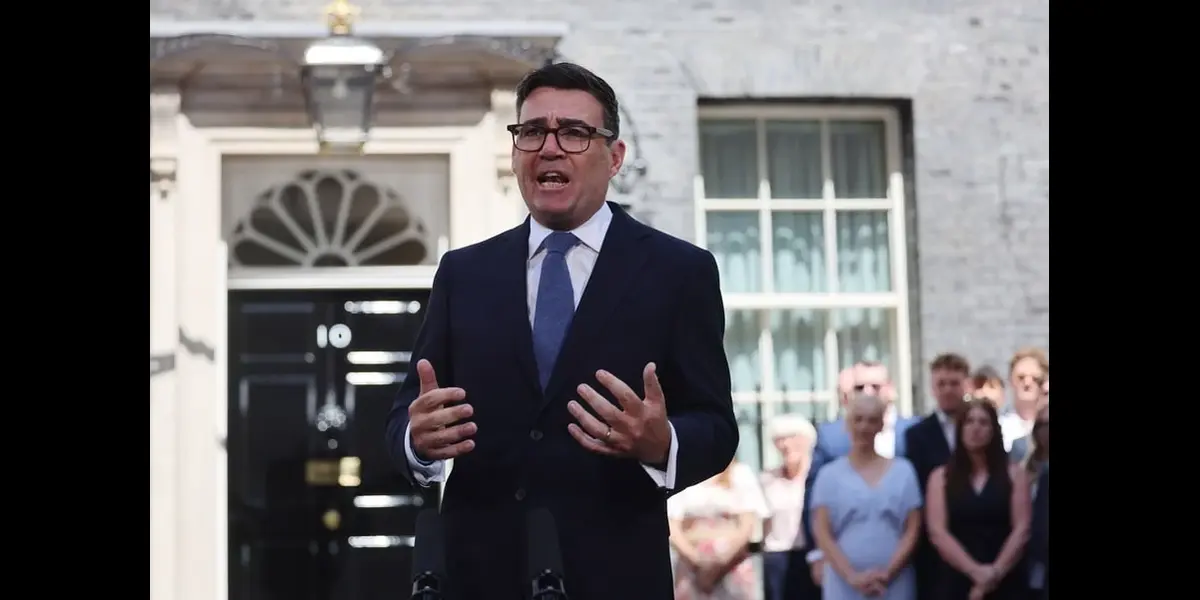
The Prime Minister used a City of London speech to call for a new start with Brussels, days before a key UK-EU summit.
Prime Minister Andy Burnham told the Lord Mayor’s Banquet in London on Monday 16 November that the promise of Brexit had not been delivered and that Britain must reset its relationship with the European Union. He argued the reset was needed to counter a growing global drift towards isolationism.
“Lost more than we have gained”
Burnham compared the outcome of Brexit to the fairy tale of The Emperor’s New Clothes, in which nobody will tell the ruler he is naked. He said he tries to say things as he sees them, and that the UK has lost more than it has gained in the past ten years. In his view, the “hard Brexit” the country ended up with is not good enough for Britain.He also took aim at the central slogan of the Leave campaign. Burnham said the pledge to “take back control” of the country’s borders, laws and economy had not been met, and that trade with EU countries had dropped sharply. He put estimates of the economic damage at between 4% and 8% of UK GDP.The Prime Minister also placed Brexit in a wider international context. He described it as the first domino to fall in a global shift towards isolationism and protectionism, and said Russia had wanted disunity within NATO and a weaker Europe. Having become Britain’s seventh prime minister since 2016, he said the country was now back on the world stage and well placed to lead in an era of renewed international cooperation.
Three tests for any deal
Burnham set out how he will judge any agreement with Brussels. It must be consistent with Labour’s manifesto and red lines, improve the Brexit deal so it better matches what people voted for in 2016, and pass what he calls his “Makerfield Test”, a benchmark for delivering real improvements in parts of the country that have felt neglected.
What happens next
The speech came just days before a UK-EU summit in Brussels on Friday. The UK is expected to seal a deal on trading food and drink, and to agree measures on energy and emissions and a scheme letting young people work for limited periods across Britain and the EU.
The food and drink deal could matter to businesses and shoppers alike. The government says British exports fell by 21% between 2018 and 2024, with EU exports down 7%, which it puts down to extra costs, paperwork and delays at borders. Reducing red tape and border checks is among the summit’s main aims.
Burnham said he will open a discussion with EU partners on Britain’s long-term relationship with the bloc soon after the summit. His spokesperson, Tom Wells, said no assumptions are being made and that the British public will be “the boss” of any outcome. Burnham also said the government would introduce a bill next week setting out its approach.The limits
Despite the strong language, the speech does not signal a return to the EU. Until the next general election, Burnham remains bound by the pledge of his predecessor, Keir Starmer, not to rejoin the customs union or the single market. Reports of the speech also say the government will respect Labour’s red lines on freedom of movement before the next election in 2029.
The politics remain sensitive. Dropping that pledge would reopen a question that split the country, as the 2016 referendum was decided 52% to 48% in favour of leaving. The Conservatives have reacted critically, accusing Burnham of trying to pull the UK back into EU frameworks and arguing that alignment with EU rules could undermine its independence on trade.
Why it matters
The speech is the clearest sign yet of how Burnham intends to handle Britain’s most divisive political issue. His message is that the UK should seek practical gains on trade, food, energy and mobility within limits he has already accepted, rather than reopen the old arguments about rejoining. Friday’s summit will show how much of that the EU is willing to agree to, and whether the results meet the tests he has set himself.