
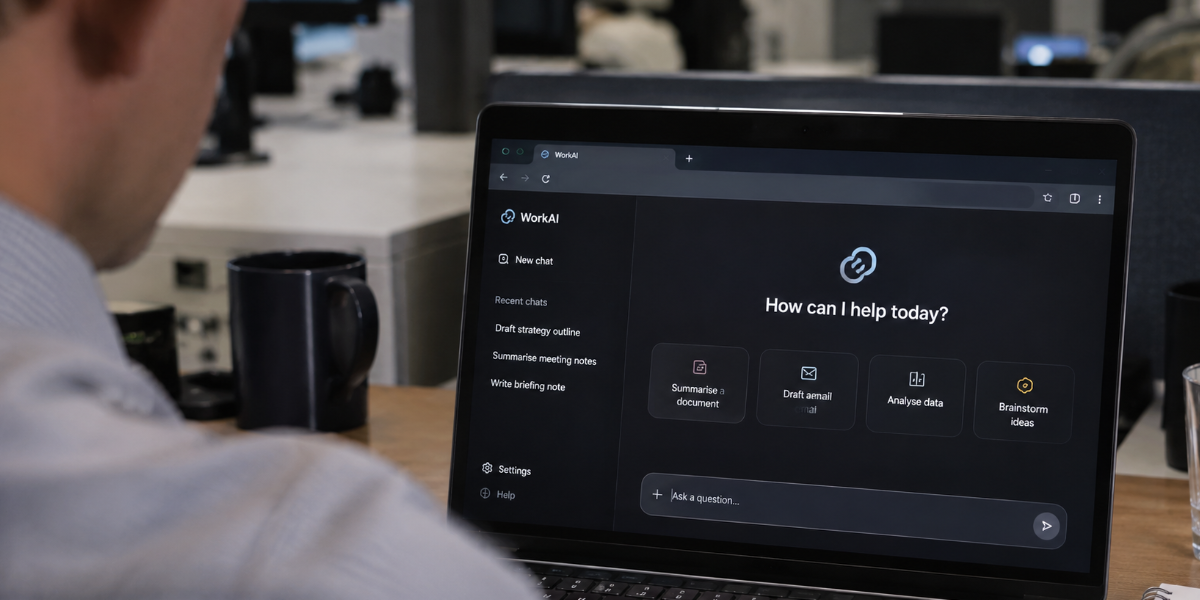
Artificial intelligence is moving rapidly from an emerging technology into everyday business operations. But as adoption accelerates across the UK, questions remain about whether West Midlands employers have the skills, infrastructure and strategies needed to make effective use of it.
Artificial intelligence is no longer confined to technology companies and research laboratories.
Across the UK, businesses are using AI-powered tools to produce content, analyse information, support customer services and automate administrative processes.
For some organisations, these technologies offer opportunities to reduce costs, improve productivity and free employees from repetitive work.
For others, AI remains an unfamiliar technology accompanied by uncertain returns, security concerns and questions about its impact on employment.
The West Midlands, with its diverse economy spanning manufacturing, professional services, recruitment, logistics and technology, faces an important challenge.
Can its businesses move beyond experimenting with AI and begin using it to deliver measurable improvements?
Adoption is accelerating
The latest evidence suggests that artificial intelligence is becoming increasingly common in British workplaces.
According to the Office for National Statistics, approximately 30% of businesses reported using at least one form of AI technology in September 2026.
Among businesses employing 100 or more people, adoption reached approximately 51%.
For businesses with fewer than ten employees, the equivalent figure was 29%.
These differences highlight a significant challenge.
Larger organisations often have greater financial resources, established technology departments and dedicated personnel capable of implementing new systems.
Smaller businesses may have fewer resources to assess emerging technologies, manage data security or train employees.
Yet smaller companies can potentially benefit from AI in precisely the areas where administrative pressures are greatest.
The challenge is identifying where the technology offers genuine commercial value.
Using AI is not the same as transforming a business
One of the most important distinctions in the AI debate is the difference between individual tool usage and meaningful organisational adoption.
An employee using a chatbot to draft an email is using artificial intelligence.
But that does not necessarily mean their employer has transformed its operations.
Genuine business transformation requires organisations to examine how information moves between departments, how decisions are made and where time is being lost.
Consider a recruitment business.
AI might help draft vacancy descriptions, organise candidate information or summarise employer requirements.
But the greatest operational benefit may come from connecting those functions with an existing customer relationship management system, allowing information to move through a structured process.
Similarly, a manufacturing company may use AI to analyse production data, but meaningful improvement depends on the quality of that data and whether the analysis leads to better operational decisions.
The technology itself is only one component.
Processes, employees, data and management remain essential.
The productivity opportunity
Improving productivity is one of the strongest arguments for business adoption.
Administrative work consumes substantial time across many organisations.
Preparing reports, updating records, reviewing documents and responding to routine enquiries are necessary activities, but they can reduce the time available for higher-value work.
AI systems may help employees complete some of these tasks more efficiently.
For a small business, even modest time savings can be commercially valuable.
However, productivity improvements should not be assumed.
An AI-generated document that requires extensive correction may offer little advantage over producing it manually.
An automated process that creates inaccurate customer records could introduce additional work rather than reduce it.
Businesses therefore need to evaluate AI against measurable outcomes.
How much employee time has been saved?
Has the quality of work improved?
Have operating costs fallen?
Has customer service become more effective?
Without these measures, organisations risk confusing technological activity with genuine progress.
A growing divide between businesses
The government’s 2026 AI Adoption Survey found that 32% of UK businesses were using at least one AI technology, compared with 16% in the previous survey.
The research also identified considerable variation between sectors and business sizes.
Businesses operating in information technology and other knowledge-intensive industries were more likely to adopt AI than those in some traditional sectors.
This matters for the West Midlands.
The region’s economy includes a substantial manufacturing base alongside growing technology, professional services and life sciences industries.
If adoption progresses unevenly, businesses operating within the same regional economy could develop very different levels of productivity and digital capability.
Companies with effective systems may become better equipped to respond to customers, analyse performance and manage growth.
Those that delay adoption could find themselves competing against organisations with increasingly efficient processes.
Nevertheless, adopting AI without a clear business purpose is unlikely to deliver a competitive advantage.
The objective should be better business performance, not technology adoption for its own sake.
What happens to jobs?
Perhaps the most significant public concern surrounding AI is its potential impact on employment.
Administrative roles, customer service functions, marketing and elements of professional services are all exposed to changes in how work is performed.
However, exposure to AI does not necessarily mean that an occupation will disappear.
Many jobs involve combinations of technical tasks, communication, judgement and interpersonal relationships.
AI may automate certain activities while increasing the importance of others.
For example, a customer service employee may spend less time answering routine enquiries and more time resolving complex problems.
A marketing professional may use AI to support research and content production while remaining responsible for strategy, accuracy and creative decisions.
The effect on employment will depend on how organisations implement these systems.
Some may use productivity improvements to increase output without expanding their workforce.
Others may redesign roles, create new positions or invest in additional services.
The critical issue is whether employees receive the training needed to adapt.
The importance of trust and governance
AI adoption also creates new responsibilities.
Businesses must consider how customer information is processed, whether systems produce reliable outputs and who remains accountable for decisions.
The government’s 2026 survey identified concerns about accuracy, bias and data protection among businesses considering or already using AI.
These concerns are particularly relevant in recruitment, healthcare, finance and other sectors where decisions can significantly affect individuals.
AI systems should not be treated as automatically accurate simply because they produce confident or convincing responses.
Human oversight, appropriate safeguards and clear organisational policies remain essential.
A defining period for regional businesses
The West Midlands has the opportunity to benefit from AI across multiple industries.
Its manufacturers could use intelligent systems to improve operational planning.
Recruitment businesses could reduce administrative workloads.
Professional services firms could improve document processing and information management.
And smaller employers could gain access to capabilities previously associated with much larger organisations.
But success will depend on more than purchasing software.
Businesses need to understand their processes, develop employees’ capabilities and identify opportunities where technology can produce measurable returns.
The question facing West Midlands businesses is no longer simply whether they should consider AI. It is how they can use it responsibly, effectively and commercially before competitors establish a lasting advantage.