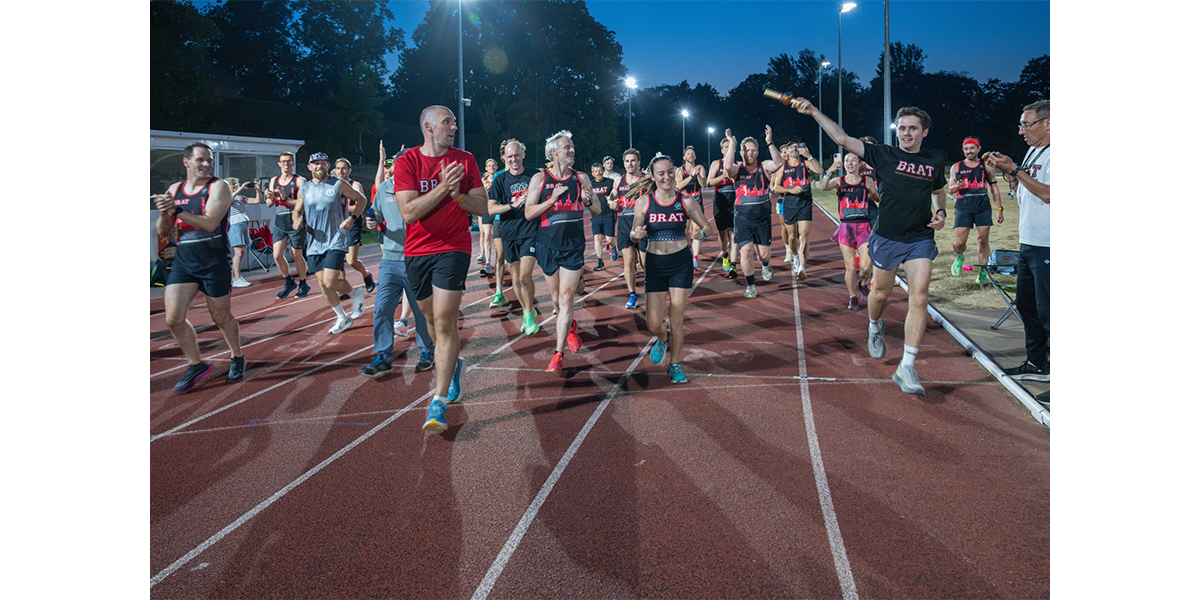
The BRAT (Birmingham Running, Athletics and Triathlon) Club brought together 43 runners for a challenge with a difference: could we collectively run a marathon faster than the world’s best can do it alone? From world championship medallists to those who had only recently taken up running, everyone had 400 metres to play their part. What followed was a brilliant evening of club sport – and an extraordinary lesson in just how fast the world’s best marathon runners really are.
The 2026 TCS London Marathon rewrote the record books. Sabastian Sawe became the first man to break the two-hour barrier in a championship marathon, crossing the line in an astonishing one hour 59 minutes and 30 seconds. Behind him, the top three men all finished inside the previous world record, while Tigst Assefa set a women’s-only world record. It was one of the greatest days of marathon running ever witnessed.
It is difficult to fully comprehend these extraordinary achievements from the comfort of a sofa. It is easy to admire the effortless stride and astonishing finishing times, but much harder to appreciate what those numbers really mean. The BRAT club decided to find out.
On a warm evening at the University of Birmingham athletics track, 43 club runners of all ages and abilities, lined up with a simple challenge: could we, as a relay team, keep pace with Sabastian Sawe’s winning London Marathon performance of one hour 59 minutes 30 seconds. That’s 68 seconds per lap – around 4 minutes 33 seconds per mile.
A marathon covers 26.2 miles, or just over 105 laps of a standard 400 meter running track. Sawe covered every one of those laps at an astonishing pace of around 2 minutes 46 seconds per kilometer without a break, without a handover and without fading. Most club runners can hold that speed for a few hundred meters. He sustained it for more than two hours.
One by one, runners took their turn – 400 metres, 68 seconds, then get the baton to the next pair of fresh legs. The incoming runner was already accelerating before the handover to avoid losing precious seconds. Some of our faster runners could dip under the target and build a small cushion, but the clock never stopped. Everyone with one aim; to stay on this relentless pace to match Sawe’s marathon-winning run.
There was no creative accounting. A qualified track official oversaw the attempt, two watches travelled with the baton and coaches and spectators ran multiple stopwatches. An official lap counter ticked ever downwards from 105 towards one – before the whole squad joined the final lap to bring the last runner home.
The verdict? We crossed the line in 1 hour and 56 minutes. It was a fantastic achievement by the club, but it left us with an even greater appreciation of the man we were trying to emulate. Forty-three runners – including experienced marathoners and triathletes, world championship endurance medallists and HYROX world champions – had needed fresh legs every 400 metres to reproduce what Sawe achieved entirely on his own. That is the gulf between the very best elite athletes and the rest of us.
It’s a reminder that the best marathon runners are not simply fitter versions of the rest of us, they operate at the outer limits of human performance. Years of training, exceptional physiology, remarkable efficiency and extraordinary mental resilience combine to produce performances that seem almost impossible.
The evening wasn’t only about celebrating elite sport. It was also a celebration of community. Forty-three runners, across seven decades of life with different running experience, came together to take on a challenge, encourage one another and share a unique experience. There was plenty of laughter, lots of friendly competition and, by the end, plenty of tired legs.
Elite sport captivates us because it expands our understanding of what the human body can achieve. For one unforgettable evening, 43 of us borrowed just 400 metres of Sabastian Sawe’s marathon. That was enough to leave us with a lifetime of respect for the other 41.8 kilometres.