New forecasting tools developed through a £20 million UK research programme are protecting flights, GPS navigation and the UK electricity grid from severe space weather.
Technologies developed through the five-year SWIMMR (Space Weather Innovation, Measurement, Modelling and Risk) programme initiative are already being used in live forecasting systems to help the UK respond faster to extreme space weather events.
A recent independent evaluation, carried out by Frazer-Nash Consultancy, highlights how the programme is transforming the way the UK prepares for major solar events that can disrupt satellites, aviation and power networks.
Space weather and why it matters
Severe solar storms can disrupt technologies and infrastructure that modern society depends on every day.
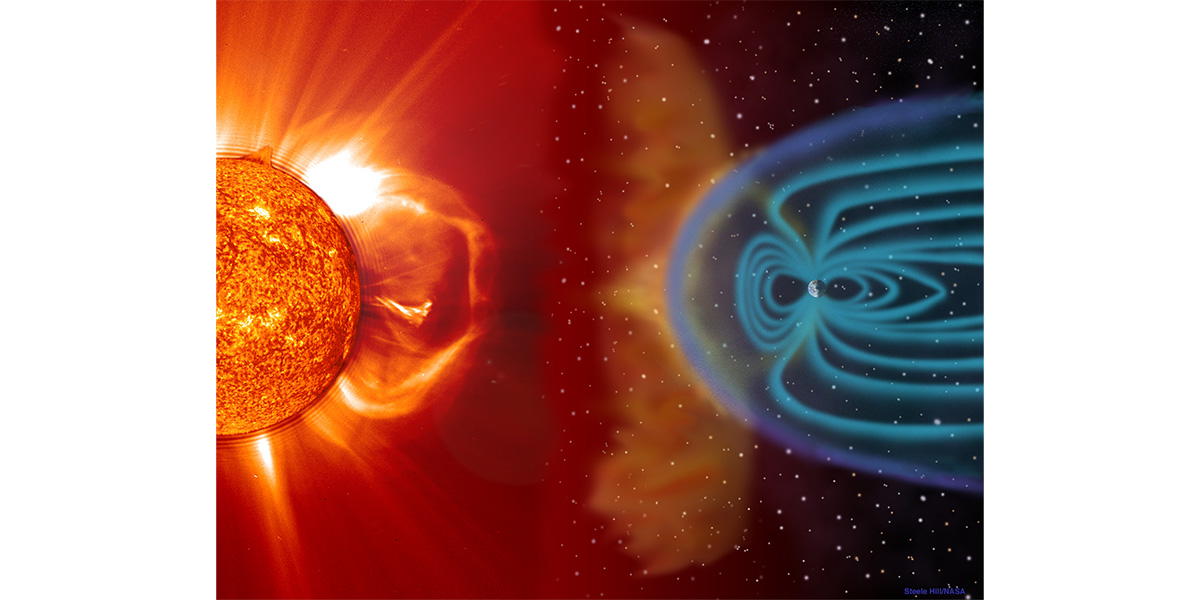
These events are triggered by huge eruptions of matter from the Sun, known as coronal mass ejections, which can interfere with satellite communications, navigation systems and electricity networks on Earth.
Space weather is classified as a top-tier national risk in the UK’s National Risk Register, in the same category as pandemic disease and major flooding, and the economic consequences could be significant.
A report published by the National Audit Office earlier this year highlighted that a 2022 estimate put the potential economic impact of a severe space weather event at £9 billion.
Forecasting a solar storm in real-time
When a powerful geomagnetic storm swept across Earth in May 2024, bringing a rare display of the Northern Lights across the UK, scientists at the British Geological Survey (BGS) were keeping a close eye on something else – the effect of the aurora on the electricity grid.
Using a new forecasting system developed through the SWIMMR programme, they had previously identified which substations were most at risk of elevated earth currents generated by the aurora.
This was the first big test of the system which gives operators earlier warning of dangerous electrical imbalances, helping reduce the risk of disruption to critical infrastructure during severe solar storms.
It was the first time the UK had possessed this level of operational foresight.
Building the UK’s space-weather capability
Led by the Science and Technology Facilities Council (STFC) and the Natural Environment Research Council (NERC), SWIMMR was delivered in partnership with the Met Office, British Geological Survey, British Antarctic Survey and the UK’s national space laboratory, RAL Space.
Running from 2019 to 2024, SWIMMR also brought together universities, national laboratories and industry partners across the UK and internationally, with STFC’s RAL Space managing the overall programme, as well as several key instrumentation and infrastructure projects.
Funded with £20 million from UK Research and Innovation’s (UKRI) Strategic Priorities Fund, the programme was commissioned to deliver against three major challenges by finding solutions to:
- improve the accuracy of space-weather forecasts
- expand access to reliable data from space, aircraft and ground-based sensors
- accelerate the transfer of scientific research into operational forecasting systems used by government and industry
Building real-time space resilience
STFC’s Professor Ian McCrea, Resilient Society Theme Lead at RAL Space, and Head of the SWIMMR Programme, said: “SWIMMR has delivered a major advance in the UK’s space-weather capability, turning cutting-edge research into improved operational forecasting tools to protect satellites, aviation and the electricity grid. It has strengthened the UK’s ability to understand and respond to severe solar activity in real-time, placing the UK among the leading nations developing operational space-weather forecasting capability, through close international collaboration.”
From research to daily forecasting
The recent evaluation says that SWIMMR delivered against all three programme challenges, significantly accelerating the move from scientific research into operational space-weather forecasting.
Through the programme:
- Five UK-developed forecasting models (covering radiation hazards, solar wind, ionospheric disruption and impacts on electricity networks) are now moving into operational use at the Met Office Space Weather Operations Centre (MOSWOC).
- A new cloud-based platform has reduced the time needed to transfer forecasting models from research into operational systems from several years to approximately six months.
- New measurement tools are already supplying live data to MOSWOC, helping operators respond more quickly to threats affecting satellites, communications, aviation and the power grid.
Full integration into operational services is expected by the end of 2026.
Faster data, earlier warnings
Simon Machin, manager of the Met Office Space Weather Programme and meteorologist, said: “SWIMMR has fundamentally changed the way we bring space-weather research into operational forecasting. By working directly with researchers throughout the programme, we have been able to move new models and data streams into live forecasting far more quickly than was previously possible. That means better situational awareness during severe space-weather events and earlier warning of potential impacts affecting satellites, communications, aviation and the electricity grid.”
From research to real-world impact
In total, SWIMMR comprised 11 connected projects spanning universities, national laboratories and industry partners.
Four of the projects highlight the scale of the UK’s improved preparedness for extreme space weather:
- Protecting satellites in orbit
Every day, hundreds of satellites carrying GPS, weather and communications data pass through invisible belts of high-energy radiation that can damage onboard systems. Before SWIMMR, the UK had no real-time forecasts for these regions.
Led by NERC’s British Antarctic Survey with Imperial College London, the universities of Reading, Northumbria and Sheffield, and the Met Office, the project delivered the UK’s first operational capability to forecast high-energy electron dynamics across multiple satellite orbits.
The model is now in pre-operational use at the Met Office Space Weather Operations Centre (MOSWOC), supporting services from navigation systems to satellite communications.
- Protecting flights on polar routes
At cruising altitude on polar routes, passengers and crew receive significantly more radiation than on a standard flight, which can increase sharply during solar storms.
The University of Surrey developed and installed radiation sensors on commercial aircraft and high-altitude balloons, feeding real-time data directly to the Met Office.
Using these measurements, the University of Surrey developed ‘MAIRE+’, the UK’s first real-time model of aviation radiation exposure during normal and solar storm conditions. It is an advancement on an existing operational model, ‘MAIRE’ (Model for Atmospheric Ionising Radiation Environments).
An additional model, MAIRE-R, extends this modelling to very high altitudes, supporting future aviation needs, with both models now in pre-operational use at the Met Office.
- Protecting the UK power grid
When a solar storm strikes, it drives invisible electrical currents through the ground and into the infrastructure built on top of it, stressing power transformers and risking outages across the grid.
Before SWIMMR, the UK lacked the modelling tools to predict where these impacts would be most severe.
Led by the British Geological Survey, this project delivered the UK’s first end-to-end forecasting system for geomagnetically induced currents.
Its value was demonstrated during the May 2024 solar storm, when the model identified the substations where transformer alarms subsequently triggered.
The National Electricity System Operator (NESO) has since commissioned follow-on research with SWIMMR partners and the Met Office to better understand how extreme space weather could affect future electricity grid resilience.
- Testing electronics against space weather
Modern electronics in aircraft, cars and hospital systems are rarely tested against the kind of radiation levels produced by major solar storms.
The ChipIr facility, part of STFC’s ISIS Neutron and Muon Source, has long been used to study how neutron radiation affects electronic components. Through SWIMMR, its capabilities were upgraded and expanded with NILE (Neutron Irradiation Laboratory for Electronics).
NILE enables engineers to test how electronics perform under complementary radiation conditions to those available previously at ISIS and provides an independent facility which can be used even when ISIS is undergoing scheduled maintenance.
It has also shown that solar-driven neutron events can trigger cascading failures in vulnerable components, with implications beyond the space sector.
The only facility of its kind in Europe, global technology companies are now using ISIS to test network routers, data centre hardware, and high-power semiconductors.
Strengthening UK space-weather resilience
The independent evaluation concludes that SWIMMR has delivered a step-change in UK space-weather capability, spanning research, operations and industry.
Professor McCrea said: “SWIMMR has created a major advance in the UK’s space-weather capability, strengthening the ability to protect critical infrastructure, services and the wider economy from the impacts of severe solar activity. “The priority now is ensuring these advances are embedded in operational services and continue to evolve through real-world use.”
Read the full independent evaluation report at the STFC website.