Mars has long been described as a dead world, a cold desert where the volcanoes went quiet billions of years ago. A new study suggests it may be more accurate to say Mars is sleeping. The research doesn’t prove there is active volcanism on Mars, but it offers the strongest hints yet that hot magma could still lie beneath the surface.
What the scientists found
The discovery comes from the ExoMars Trace Gas Orbiter (TGO), a spacecraft circling Mars. The study was published on 4 November in the journal Science Advances. It was led by Alexander Trokhimovskiy of Russia’s Space Research Institute.
The team detected a gas called hydrogen chloride. TGO first reported the gas in Mars’s atmosphere back in 2021, and it is commonly found escaping from magmatic vents on Earth, leading researchers to wonder whether the same was happening on Mars.
A gas that broke the pattern
Hydrogen chloride normally follows a seasonal rhythm on Mars. It reaches its maximum in the northern hemisphere’s winter and mostly disappears in summer, and most of this variation appears to be linked to the planet’s dust and water cycles.
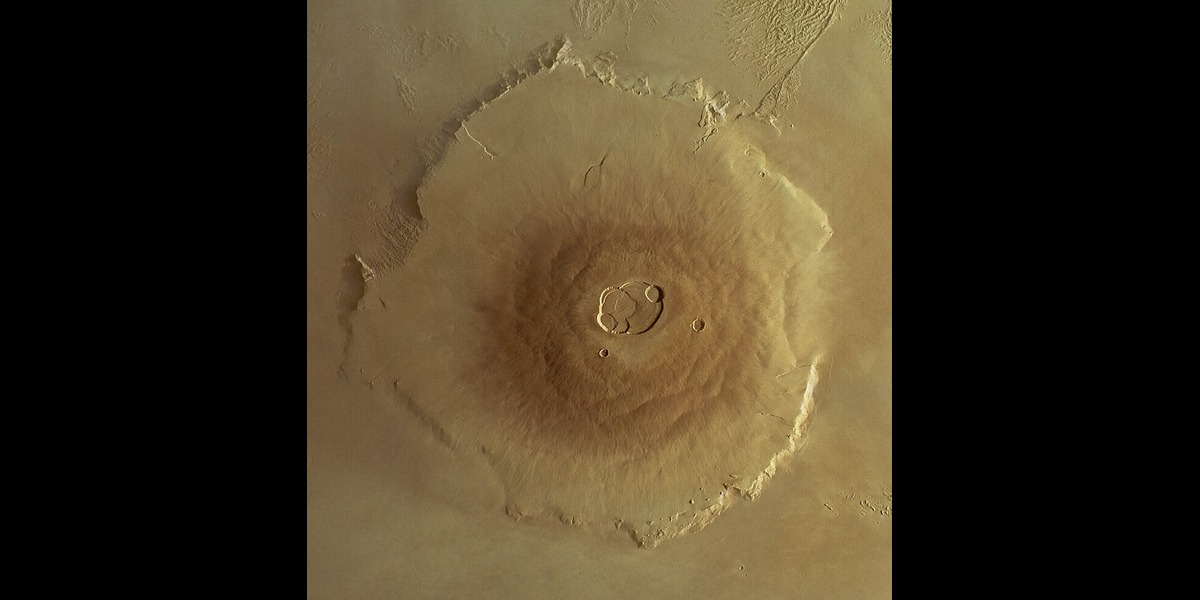
But there was one exception. Always in the same season and at the same place, the gas appeared above volcanic fissures on the flanks of the Alba Mons volcano in early summer. Alba Mons is the largest volcano on Mars by area.
Cracks in the ground
The team then looked at the area with the orbiter’s camera. The images showed fresh, narrow fissures, in some cases hundreds of metres long, linked to colour changes on the surface.
The researchers think gas is rising through these cracks, like vents on Earth called fumaroles. The discolouration could come from deposits left behind by escaping gases, as it does around fumaroles on Earth.
Why only in summer?
The team has an explanation for the timing. In winter, with temperatures as low as -120°C, ice blocks the fissures. In early summer, the ice sublimates (turns directly from solid to gas) and the cracks can release the gas. Rising air temperatures in early summer let volcanic gases trapped underground escape into the atmosphere.
The researchers suggest the gas is connected to a dormant magma chamber, a kind of volcanic plumbing system beneath the Martian surface. Dormant means sleeping, not extinct.
How they spotted it
The gas was detected by infrared spectrometers on TGO, and the fissures were imaged by its CaSSIS camera. The fissures were also imaged by the HiRISE instrument on NASA’s Mars Reconnaissance Orbiter.
The task was far from easy. Co-lead author Daniel Mège, of the Polish Academy of Sciences, said it was like looking for a “needle in a haystack.” He said the orbiter found a handful of molecules from a possibly intermittent source while moving along its orbit.
What this does not prove
It’s important to be clear about the limits. No new lava flows or eruptions have been observed, so the case rests on the gas detections and the shape of the fissures rather than a direct sighting of activity.
One report puts it plainly: the study suggests Mars may be volcanically active, but has not proven it. It is an observational study combining spectroscopy, imaging and modelling.
Mars has a history of such hints. The planet has the largest volcanoes in the Solar System, but it is not known how active they are. Orbital imagery suggests some volcanoes were active within the last few million years, and seismometers have detected marsquakes. That is recent in geological terms, not in human terms.
What it could mean for life
The finding also has implications for the search for life, but the sources are careful to say “could”. If lava rising through the crust meets groundwater, this could create warm, habitable niches. Mège said looking for Martian life in the seeping fissures of Alba Mons would make a lot of sense, because active hydrothermal systems could provide the ingredients and energy microorganisms need, and shelter them from the harsh surface.
That is a hypothesis for future exploration, not evidence that life exists on Mars.
Why it matters
ESA’s project scientist for the orbiter, Colin Wilson, said the findings may prove to be TGO’s greatest success yet. If the explanation holds up, it would change how scientists think about Mars: not a frozen, finished world, but a planet that has kept some of its inner heat. Mège said Mars may have retained enough internal heat to support volcanic activity until recently, and possibly still does.
For now, the evidence points to a planet that is quiet, not dead. Further observations will be needed to find out whether the gas keeps appearing in the same place each summer.